Wednesday, June 28, 2017

Could proactive measures have done anything for the Ghost Ship Fire? What's your opinion? Here's mine..

  There are many predictable emergency's that we are able to pro-actively prevent. If we live in a remote area where we are surrounded by dry brush up to the house, many if not most of us would clear it. If we live on a hill and a pipe sprung a leak eroding the soil on the way down we would most likely shut the water off and fix the leak. In other words if we can expend a little amount of effort right now to eliminate a serious result most of us would perform the task or complete the repair.
  There are many disasters we can not predict to enable us to take precautions to lessen the results. Dam's failing, sinkholes, bridge collapses and many other unpredictable events.
I don't think there is many of these water pipes in the
world, who knows.
  This makes me wonder about some buildings that have burned to the ground and taken many lives with them, tragic. I'm talking about the warehouses being occupied by people taking on the renovations them selves, they are all over the country. All are occupied by good people with good intentions merely trying to survive. Artist, musicians and writers, mostly young and just beginning their lives. They rent a space, then have free access to modify it. It's a good game plan, as long as the buildings are up to code. Some of the people that did not make it out of the ghost ship fire in Oakland California on December 6, 2016 were caught in an upstairs area with no way out, one rickety staircase built by the occupants. It brings up the topics of code enforcement's, inspections by the fire Marshall's and building inspectors, OK that's a given all of that will come up in investigations and inquiry's. That really has to occur, and it is as this is being written.
  I have seen pictures and news films about the Ghost Ship Fire in Oakland, I live about 50 mile NE of that city. The photo's I have seen show stacks of "stuff" everywhere, pallets, a few pianos, tires as well as all kinds of artist supplies. It appeared isle ways with stuff on each side, flammable stuff. As the camera's pan over the destroyed warehouse showing the burned cinders of all the debris I can't help but think of a couple of things:
  1) I didn't see any dumpsters, I don't know where people placed their trash maybe there  were garbage cans somewhere I don't know. There should have been a large dumpster, requested by the occupants and supplied by the owner/landlord. Would it have prevented the fire? No, but it would have conveyed a message, "if you don't need it toss it". Which brings me to the next point.
Pallets burn great, I watched a stack like this burn, it was fast
and very very hot. 
  2) It may be my Navy training, on my ship we had a lot of fires, big fires, small fires some that were deadly. It was very important for each sailor to take responsibility when a spot was seen that was a fire hazard to immediately clean it up. If I was unable to, then make sure I tell someone about it. (One reason to pass it on would have been watch duty). I wonder in the warehouse's if anyone ever looked around and said to themselves "man this place is a fire trap." the next thought should have been "we've got to clean this place up". To me that's basic pro-active disaster prevention, pile all the pallets up outside and get rid of them. The paints, cardboard and paper all in the dumpster, would it have prevented the fire? Most likely not, but it may have, and it may have slowed it down enough for more people to get out. The National Fire Prevention Association's website goes into detail, click here.

USS Forestall fire, 1967, great lose of life. 
I would not think about pointing blame, in a situation like this it's so very tragic and heart breaking there is enough blame to go around, but it has no place. Responsibility, hey that too was everyone, that fire and the ones like it mainly created victims, the deceased, the owners, the landlords and mostly the families of the ones that did not make it out. The courts will sort all of that out, I won't and can't.
  The message I want to send is if you're living in a space like that, stand up look around and ask your self "Would I be safe if this place started on fire?" If the answer is No, get the landlord to supply a dumpster then organize the occupants and make the place safer. Ask about the electrical system, look around for extension cords running everywhere, fire extinguishers should be around, and exit routes. A major problem is when the fire Marshall show's up, performs an inspection and comes up with a repair list, instantly he's the "bad guy", go figure. After a disaster like one of these fires, he's blamed then for not performing "enough" timely inspections, and if they were timely then the accusation is he didn't enforce it strongly enough. They are in a very tough spot.

  Thanks for reading, write a comment I'd like to hear from you.

jimandkate  EmergencyKitsPlus.com

Monday, June 26, 2017

How proactive are we really in being prepared for the inevitable emergency's? What do trees have to do with it anyway....

  I have found that most people are like I am in their appreciation of trees, yes trees. I don't believe I have ever met someone that did not like them a lot or absolutely love them. I am in the love group, I find it so enjoyable to sit and look at a tree very closely. I spend a few hours every day sitting on my river side porch or in my garden, normally I have my binoculars around my neck and my bird book real close. Mostly I study the trees, the crows, squirrels, and song birds, there is a lot life in just one tree. Each species has a different color leaves, I worked on the ranches for a while which taught me the different shapes of trees. I am able to tell almonds from walnut from fruit trees, they all have a certain shape and color. I like trees a lot. What kind of tree do you have? Check it out click here.
This is not my Bay tree, I copied this picture from google
images, it's an Oak. 
  Trees are extremely strong, my attention has been drawn to writing about them today due to the wind and my two Bay trees on the levee. These two trees are huge, about 30 feet high with a matching diameter. I don't know who planted them or when, I suspect they have grown from volunteers because they are so close together. The main trunks are about 8 feet apart at the ground, the tops of both trees have combined so they appear to be one tree. The trees are about 15 feet from my deck and when the wind blows I wonder if they will ever topple over and destroy part of the house. They need to be trimmed for sure, for their survival in a wind storm and mine for destruction or worse. So I see this as a "survival" issue. This is what being prepared for an emergency is, being proactive in discovering problems before they become one. The wind is blowing 11-17 mph today, I watch the big crown of leaves move with the wind (they generate quite a bit of noise as well), I marvel at how very few limbs bend. It looks like a sail on a boat maybe that was the inspiration for the ancients to use sails on their boats. We have had winds up to 80 mph, in fact the planning commission requires patio covers on our island to be rated for 80 mph winds. Wind prep advice can be read here.
I'm not sure the word "odd" is the feeling the driver had in
his stomach, whoa is more like it. 
  If the trees are blown over there is a possibility due to them being on the levee that it could be a catastrophic breach. That's a worry, although the levees on our island are in very good shape regardless of what the politicians say, we pay to maintain our own. There are however numerous things we keep an eye on, our municipal district maintains them, we need to inspect them. We look for animal burrow holes, beavers, ground squirrels, otters and other water inhabitants. One concern is tree roots, if a tree dies on a levee the roots will rot. When they deteriorate a void is left underground, it may fill with water or worse fill and empty with the tide causing internal levee erosion. It may cause a breach, beaver dens are capable of causing the same result. A beaver den was found in the levee that was as big as a 3/4 ton pickup truck, although rather rare it does happen. There is a lot to a levee, there is a lot to living on the bank of a river, erosion is a huge concern.
  So back to the Bay trees, I need to have them trimmed professionally, I am unable to do that kind of stuff any longer. I'm getting up in the years and I cannot walk, so I'm out of the question. I cut a tree down once, it was a huge Elm (I don't like to think about it) I was 25 years old and did not see the future all that clearly. I regret to this day doing that. I will write a blog on how the trimming goes. In my opinion proactive efforts to eliminate the threat of issues that have the ability to intensify our reactions to an emergency have a real spot in emergency preparation.
  Pro-active efforts include:
1) Developing and putting in writing a detailed plan. FEMA has a planning site it's here.
2) Stocking enough water and food items to sustain each person for a minimum of 3 days.
3) Charging electronic devices every evening
4) Making sure our vehicles are in good working order, with gasoline in the tank.
5) Knowing our neighbors and including them in our planning
6) Keep our outdoor areas capable of with standing storms, fires and other threats we noted in our plans which are our main threats.
It's important to know your neighbors, these people live in
Louisiana, a place with a lot of disaster potential, they are
very self reliant. 
  Every once in a while I re-state my idea's and practices dealing with disaster preparation. I believe in preparing for the short term, government entities suggest be prepared for the first 3 days, I agree with that. Preparing for a longer time period begins the start of a change of lifestyle, it can get involved. My desire is everyone has for each person a three day or 72 hour emergency kit, pre-packaged or packed individually, something is better than nothing.
  Thanks for reading my blog I enjoy writing it, leave a comment, question or suggestion I like to hear from you all. Thanks.

jimandkate   emergencykitsplus.com

Saturday, June 24, 2017

Are we crazy or or prepared? Here's two things we can do to prepare for a natural disaster

  Portland Oregon conducted a survey on Emergency Preparedness, the objective was to determine to what extent people in that area were prepared for a natural disaster. People in the Pacific Northwest are aware that a disaster may occur at any moment, (Mount Saint Helen's comes to mind)
It's a beautiful mountain, Mount Saint Helen's. 
the area is prone to earthquakes. 75% of the residents believe a natural disaster will occur within the next 10 years, However awareness is not enough to convince people to prepare. Only about 1/2 of the population have put together some sort of an emergency kit, they are as prepared as other parts of the country. The people of Portland are under the belief that knowing their neighbors well is the first step in being prepared for a disaster, unfortunately very few have developed a plan with each other. The survey results also included a question pertaining to who they would rely on after the event took place, who do they expect to be available to help them? Almost 40% replied they would expect emergency responders, 65% are of the mind their house mates will be there for them, of course we rely on family and friends as well 60% and neighbors 40% expect them to be a source of help. For a good article by FEMA about basic preparations click here.
  I have to wonder if people over estimate how prepared they are for an event such as a major earthquake, I believe most of us are optimistic almost to a fault. The survey found 50% felt they were prepared with a kit and a plan to deal with the after math of an evacuation. What about the other 50%? As we know some will never prepare and others will do a few things, perhaps get started and never finish. Some just don't worry about things like that, it's all normal human nature.
 
Pack your own evacuation kit or purchase a pre-packaged one
either way you'll be prepared.
The question I have is how in the world can people be inspired to move from being "aware" to actually being ready, having an evacuation kit set up to go. I think part of the challenge is that about twice a year the local news outlets get on a "big one" bend. Announcing over the air and many times in the newspaper (I still read them) a regular campaign to make us aware of the possibilities an earthquake may occur. They mean well but all they are accomplishing is to raise peoples awareness, I think we are all aware an earthquake is going to drop California into the wide Pacific. How do we move it to prepared? Have you ever noticed how most movements that gain traction seem to be backed by a local, state or federal government agency?  Earthquake preparedness from the California department of public health has a good web site click here.
  Maybe part of the challenge is one image people have of the emergency preparedness industry, I read a blog where the writer made the statement "are preppers crazy?. I left a comment, in it I stated that the preppers, now I'm talking about the people planning on retreating to a bunker and establishing what is essentially a military "beach head". The people aren't crazy but some of their motivations may sound like it to those people not familiar with that lifestyle. I can understand it can sound scary as all get out. To answer that challenge, I stress being ready for the short term first,
Go from awareness to preparedness. 
prepare for 3 days, it will stretch into more.  Unless a person is planning to change their entire lifestyle to accommodate the totally committed prepper lifestyle, I suggest we prepare for the first 3-5 days. To prepare the way I believe is a quick way to reach a nominal level of preparedness. The two goals to reach for and complete are 1) Make a plan, everyone you expect to be affected by the occurrence needs to have a voice in the planning. 2) Purchase a pre-packaged emergency kit, they are available in many different arraignments, many are able to do double and triple duty. Once we achieve that level of preparedness, our awareness is raised and the preps become part of our life style. We're not nut's, we're just ready.
  Thanks for reading, leave a comment or suggestion.

jimandkate   emergencykitsplus.com  must have survival gear
 

Thursday, June 22, 2017

107 degrees in the shade, 120 degrees in the desert and people want to go hiking, here's me on that....

  We are in a heat wave in the Western U.S., Mark Twain said "everyone complains about the weather but no one doe's anything about it." I don't know about that, in his hey day there were still

Mark Twain. 
"rainmakers" selling people hope when there was a drought. This blog is about temperature, ambient temperatures. When I lived in the Coachilla valley of California, the valley where Palm Springs is located. We moved there in August of 1996, I put on a pair of shorts and did not wear anything else for 3 years, just shorts. I worked out side in an electrical power producing plant, that plant burned tree trimmings from the Los Angeles and surrounding areas. It was hot, dusty, smelly, dirty but good work. We were trained in dealing with the heat, a doctor would give a presentation once a month at a safety meeting giving us very good instructions on how to deal with it.
  We worked in a 2-3 person crew, taking shifts on the job if it was outside the shop. We would work for 1/2 hour, be releaved to the air conditioned shop for 3/4 hour, the people in the shop would continue to do prep work. We would dress for it, we wore a cotton hood over our heads. They are lightweight, tan in color, they were worn over the head with a small window for our faces. The face opening was even with the top of our eyebrows with the bottom just below our noses extended side to side at the edge of our eyes. Googles went over our eyes, then a dust mask to breath through, not a paper dust mask but an industrial 3m mask. Long sleeve cotton shirts, overalls, boots, gloves and that was pretty much our protection. The get up was indeed hot, but it was protection from the sun, heat and dust. I've added a link to Centers for disease control and prevention's guide on dealing with the heat, click here.
  We drank a lot of water, at least a gallon a day, room temperature and lot's of it. The company doctor advised us not to drink the sports drinks exclusively. A 50/50 solution was recommended, that's enough twice a day to replenish electrolytes. We would get soaked in sweat, as it dried we would look for the white "mineral" stains left behind. It can be an indicator on how often a sports drink should be consumed, heavy - drink it, non existent - pure water. I need to add however that we did have a tendency to drink too much gator aid, never doing any harm. Clear water supplemented with gator aid in moderation is in my opinion the best choice.
  The scourge of the desert is the fly, I don't know where they all come from but they show up thirsty. Any place there was water the flies would congregate, make a puddle in the sand, flies would cover it no matter how big it was edge to edge. It was very obvious the flies would start to die the closer to 120 degrees F the temperature got. At 122 degrees, no flies, at 122 degrees the human body can not keep cool. Ready.gov has a write up on precautions to take when in extremely hot temps, click here.
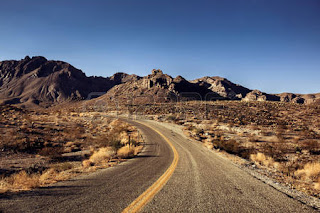
This is a long road in the desert, prepare for the worst but
expect for the best. 
  Even with our training, work rules and precautions we still had problems with the heat. I was on a 4 man crew rotating on a big job repairing a huge claw type machine. The temperature was over 120 degrees, we were working in the 1/2 hour 3/4 hour shift, it was hot. Mid afternoon everyone was feeling fine and the job was progressing well, although slow due to the heat. We were on top of a fuel pile of about 30 feet covering 5 acres or so, the claw was laying on top. When we got to the top one of the crew members passed out, no warning nothing, he just dropped like a sack of wheat. It's a very serious situation when that happens, we were all first responders as well as confined space rescue certified so we knew what to do. We carried him the 500 yards or so to the shop, the foreman called for assistance from the fire department. He recovered and continued working the next day. This particular man was from Texas, he had been out here for a few years, he could handle the heat, he knew to drink water, he was trained in what precautions to take in the heat. In other words heat stroke can happen to anyone, we can't afford to get too confident in our physical conditions.
  Arizona is contemplating creating a "heat hiking" law, (click here to read the news piece) Law enforcement doesn't think it's enforceable, first responders think it will keep people from calling for help, I say a public education program would most likely do more. Where I live we have "spare the air" days, intended to organize people to use less personal and more mass transit. Whether it works or not for cutting emissions I'm not sure of, but one thing it does is it alerts people not to exert ourselves in the heat, in other words it raises awareness. That may just be enough, I hiked in the heat just enough to learn I shouldn't, the mountains in the desert are beautiful. Maybe call the alert the "Too hot to hike" alarm, I bet people would listen and take it to heart. At the very least it would raise awareness and that's what preparing for emergency's is all about, become aware and think what can I do to make it better if it happens?
  It must be said there is a large group of high heat hikers whom are tourist, from country's with very little sun and no high temperatures. They want to experience what terrible hot heat is like, (we left the desert on a day that was 127 degrees) they have no experience, training or knowledge of the implications. I believe the local people know enough not to hike in the heat, desert dwellers are amazingly adaptable people.
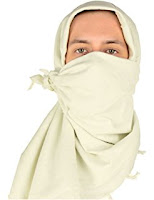
I preferred this color and material
they are available fully sewn
together as well
  I've gone on long enough, in summary, if you have to go out when the temperature exceeds 100 degrees prepare for it. Start by drinking a full pint of water immediately upon waking up in the morning, drink another before leaving the house. Don't wait until you're thirsty to drink, sip water all day long, carry it with you. Ice cold water is OK, but room temperature goes down easier. Mix water and sports drinks 50/50, take a "salt" pill if the mineral tracers on your clothes are heavy. Protect your body with clothing, in the heat many times more is much better. Last understand your body, it will tell you when it is in trouble, if you do suffer heat exhaustion let those around you help you, we don't think we need the help but we do in that situation.
  Thanks for reading, drink water, rest, cool off and pay attention to the temperature and how your body is reacting to it, "when in dought don't go out."

jimandkate    emergencykitsplus.com  emergency kit supplies


Tuesday, June 20, 2017

Honey Bees pollinate 33% of what we eat, let's save them ... this is one way

 Let's Save the Bees how about we start today.
Native Americans called the honey bee "White Man's Fly"
Help save the bees. 

  30% of everything we eat is pollinated by bees, when we think of bee pollination we generally think of the notorious Honey Bee. Busy as a bee, industrious almost to a fault and maker of Honey, a truly amazing insect. Many of us have heard for the past few years of the decimation of the Bee population in the world, it has been narrowed down to several causes (there are many) one is a tiny mite called the "varroa mite". Two others are the Israeli Acute Paralysis virus and the gut parasite Nosema   suspected causes as well. (What's killing the bees, read a fairly long paper here.)
  Many people don't realize there were no honeybees in North America until they were imported from Europe with the first settlers.  Called the "White man's fly" by Native Americans, they had never seen a honey bee, they went extinct here 14 million years ago. (Actually earth worms share this distinction with the bees) Now they are so important to our food production it would be a disaster if they (and other pollinators) were to become extinct. 20,000 species of bee inhabit our world, our little honey bee is just one.There are some things we can do to save the bees.
  So should we plan to save all of the bees in the garden? Well we probably should but 20,000 fills up an area pretty fast, I recommend we save what is called "Solitary" bees. Most bees are solitary as a matter of fact, and we just may be try to save another species as well. Here's one native species we can help to survive:
Mason Bee entering a reed, bamboo, cat tails or tules cut
about 8" long work great, they will plug the far end with mud
hence the name "Mason Bee".
 A good paper on solitary bees may be read here.
Osmia Lignaria, don't you just love the names that we use? In normal language they are "Orchard Mason Bees". They are about 13 mm long, males are a iridescent black/blue color. There is a serious lack of nesting spots for Mason Bees, due to man's constant cleanup efforts, Mason Bees live in wood. They occupy woodpecker holes, cracks, rotted wood but they do not drill their own holes. We can build nesting boxes for them, or use our wood fences. I have drilled a bunch of holes in my fence (it's wood) just for the bees. The holes for this bee (males) should be 3-1/2" deep, be careful not to penetrate all the way through. Space the 5/16" diameter holes about 3/4" apart, a 4"X6"X6" piece of wood will have 12 rows across and 4 rows down equaling 48 holes. The females need a deeper hole, drill into the end of the 4x4 to a depth of 4-6" deep, there should be 16 holes. Sticking straws in the holes will make cleaning them out easier, then place the box facing Southeast, Mason bees like the morning sun. Keep the habitat away from plants that have been treated with pest or weed killer. She will lay her eggs in the deepest part of the hole, then she blocks the cell with mud, she will lay another egg place another slug of mud and so on. She repeats this for the entire length of the hole, the cell is made up of mud-pollen-egg-mud-pollen-egg until the chamber is filled. The eggs hatch after 1-3 weeks, the female lives as an adult for 6 weeks, she dies right after the eggs are laid. Good grief the female side of each equation is definitely the glue that keeps this world together, this is just more proof.
  After you have built your bee habitat you will probably see other species as well, don't be concerned, most bees co-habitat well. One native bee you may see is leaf cutter bees, you will know them due to lining their nest with leaves.
   We can plant different flowers, herbs and vegetables to attract the bees. Sunflowers are my favorite I purchase seeds that produce the tallest largest diameter flower, squash bees are attracted to yellow flowers, beans, peppers and lilac attract bees as well. I planted a Rosemary plant (huge bush now), great in chicken recipes and an absolute signal tower for bee attraction, that Rosemary is covered with bees this time of year. (Spring). Do not use GMO or Hybrid seeds, they are designed to not reproduce, purchase organic only. Water will also help save the bees, a shallow pan or bird bath filled with water, then place rocks and pebbles until the water barely covers them, the bees will bee able to use the rocks to get water. Read a paper on bee habitat click here.
Plant flowers, herbs and vegetables, the bees will come. This
will help save the bees. 
   One other way to provide habitat to save the bees is to contact a bee keeper, if you have room and they are in need of a place for their boxes, you may just become a landlord of bee hives. You may just have met a bee keeping mentor, most of them are happy to share their knowledge and encourage raising honey bees.
   Together we can save the bees, I started with saving the Honey bees, it morphed into providing habitat for Mason and Leaf cutter bees. Drill some holes, plant some sunflowers and set up a watering tray, if you are into self reliance like I am, it may seem like a small thing, but it is a really cool thing to do. Thanks for reading, leave a comment, suggestion or a story, we can save the bees.

jimandkate   EmergencyKitsPlus.com

Sunday, June 18, 2017

Too wet to plow and too windy to shingle, it's too hot for the garden and the dog what to do?


 I take my Heinz 57 border collie for a run 4-5 times a week, It's normally about 1/2 mile. We take a route from on top of our levee, run 1/4 mile along it (grass covered) then we go down the levee it's a hill, out on the road she runs in the weeds and grass next to the road. Then we run to the turnaround spot and do it one more time. I'm fortunate there is very little asphalt or paved services, we live in a hot climate during the summer months. I have in the yard several buckets of water, the wild critters and my dog all drink from it, I keep them filled.
Stay cool, stay cool. 
  It's vitally important when starting a supply such as the water buckets that I stay consistent, the animals do rely on it. I will go to the garden in the morning and notice tracks all around the bucket, even though the river is 50 yards away they still drink from it. It's shaded by a peach tree, on grass (I garden in raised beds) affording my dog and the critters a place to rest. Learn to set up a wild animal habitat here.
  I also know this is not advisable but I do it anyway, we grill a lot of turkey's, I will put the carcass in the garden and let the raccoons take it. If I don't the trash cans contents will be scattered all over the place. It's much less work to just let them have it, they will get it anyway they can. A short paper on the symptoms of rabies click here.
  We treated her for the seed ticks, they are history at least for this year, it was an ordeal to put it mildly. Then immediately she got infested with fleas, real bad. It is a real learning experience for me, the vet told me to look for the little black "specks" on her skin. That she said is tick feces, yes indeed, now hold your nose, that is what the ticks feed on partly. Flea treatment link here. They do feed on the dog's skin and such, but I will not rid of the ticks if the black specks are not washed off. When they are washed off, it appears the dog is bleeding, the feces is kind of red. The commercial flea treatment did not work on all dogs this year, but the pills do, I gave her the chew able pill and it is working so far. I put one in my dog emergency kit.
  I watched a red squirrel running across the asphalt roof of my neighbors house, the ambient temperature was around 100 degrees f. The dog's nemesis would take a few steps and lift it's feet up one at a time. Apparently the roof was hot and it was burning the apple thief's feet. The squirrel
Another fruit thief, it seem's they would be much fatter. 
dashed to a shady spot and appeared to get some relief. Which brings me to my main point of this blog, dog's feet need to be protected from the heat. There are a lot of ways to do it, check the temperature of the pavement. Place a hand or foot on the paved area, if it's too hot for your hand it's too hot for your pet. Go out early in the morning or late afternoon after the temps recede, and stay on the grass if possible. I will wet down the grass and weeds around my containers and let her cool her feet off, sometimes I will wet her down as well. We can buy "booties" for both cat's and dog's, we used them when I lived in the North during the winter and they are useful during the summer as well. Watch your pet, inspect their pads, if the animal is licking, chewing or paying an abnormal amount of attention to their paws take a look at them. If they are pinkish or red they may be burned, look for blisters, cuts and open sores. If there are any go directly to the vet to have them administered, or do it yourself by washing, drying, apply a antibiotic then complete it with a bandage. An interesting paper on dog's and pain is here. A paper on Cat's and pain here.

Just one more indignity foisted upon me. Couldn't he have chosen
a different color? I am a guard dog! 
From the moment we take on the responsibility of a pet, it is our responsibility to be sure they are doing well. Part of being self reliant is making sure our pet's are as self reliant as they can be as well, a huge part is making certain they are in good health. Thanks for reading, take a look at your pets pads, look for fleas and ticks, stay hydrated (everyone) and pay attention to them, they'll love you for it.

jimandkate  EmergencyKitsPlus.com  Dog Emergency Kit

Friday, June 16, 2017

The trinity Love/Hate/Indifference which is which? How are they related to our survival....

  The opposite of love is not hate, the opposite of hate is not love. They are both more emotional than logical..
   Love is a feeling of warm personnel attachment and deep affection., caring deeply about another person, a spouse, child or parent for example.
   Hate is a feeling of total dislike, passionately against, we hate the enemy, we hate the rain we mostly hate objects.
They are almost the same emotion.
   How does this make a difference when they are referenced in the same sentence or paragraph? How could it possibly relate to a disaster preparation blog? In a word, the opposite of love and hate is indifference.
   The total idea of avoidance, not caring, uninterested in a person or articles well being. Indifference can be directed towards any person, object or situation, it rears it's head in neglecting situations. It's a lack of caring, if a person is unconcerned about their own well being how in the world could they ever be concerned about anything else? An example could be made with disaster preparedness, most people suspect at some point something is going to happen in their lives. The something I'm talking about is a natural or man made event that directs your activities in a direction you would not normally take. Human nature (optimism) is to feel "everything will work out", is most of the time true, if it wasn't we would not have existed for these past couple of million years. If indifference was the dominating moral guidepost, we would not have survived as a species for very long. A lot of people feel that having a 72 hour emergency kit set up and ready to use is a great idea, they fail to act, indifference in motion perhaps. A lot of times it is economic as well, this obstacle can be overcome, indifference can't.
 
GI's in third world country's, see love, hate and indifference
every day, we tried to make it better.
It ends up most people do care about other people, we have great compassion for people in situations we can identify with such as flooding or wildfire. Most of the time disasters are a distance from where we reside, sometimes very close, but always the severity is reflected in the count of the number of people affected. If we each prepare for these unknown events in the form of having enough water and other survival stuff close enough to grab and run we would be far ahead of the field. Conversely if we prepare to the point of being in a position of helping other people that did not prepare for themselves, I believe truly it makes us better people. Love or Hate? They don't fit into the picture, what does is indifference, if we are indifferent we just pay no attention. In other words it's the "I got mine the heck with you attitude."
   In antiquity one of the worst punishments that could be doled out was banishment, it was certain death in most cases, the peak of indifference, the tribe or group decided as a whole they just did not care. Why would it be certain death? We need other people for so many reasons, even if a person is not real good in social situations, we still need human interaction. During an evacuation event or a disaster, really any situation that demands it our compassion takes over, until we get "fed up". At that point we give up on the person, object or animal and take action of some sort, banishment in this case.
The opposite of Indifference. 
   I've been thinking about indifference since I wrote the blog on being the last person on earth, how long could we live without human companionship? Could one person survive alone for say 10 to 40 years? I don't have an answer for that, how many people have lived in that situation? I've heard of WWII soldiers on pacific islands that survived for 20 years, I don't have any details on it. What about people that live in a remote area of the arctic circle? Living alone in a cabin, with a bunch of snow for half of the year would be a trial indeed.
    I have no answers, I do have a bunch of questions, the trinity Love/Hate/Indifference each has a place in our lives. I don't know if we can control these in our minds when we feign any one of them it appears as insincerity, and it is in fact.
   This is interesting to me, what do you think? Comment on your thoughts, thanks for reading the blog.

jimandkate  EmergencyKitsPlus.com