Friday, June 2, 2017

A man died in the river this week, here's one thing you can do to make sure it's not you...

    A man drowned this week in the San Joaquin/American River north of Antioch in the California Delta. A determination has not been made what the cause was, this is a very disturbing incident. We have numerous water tragedies in our area, I live on an island in the middle of the Delta. This time of year, between Memorial day and Labor day a lot of people come to the water for recreation. I like to see lot's of people having a good time, loud music, laughing, BBQ, people on the water generally are extremely friendly and face it, they're on vacation. There are a lot of beaches, places to fish and enough restaurants and gin mills to satisfy all stripes of people, it's a great place to live.
Those ain't racing suits these ladies are swimming in.
     From the newspaper article the man's hat blew off of his head, most people here wear hats due to the intense sun. They anchored the boat near where the hat was floating, after stabilizing the boat, the man jumped in. Witnesses said he was in the water for less than a minute when he started to struggle. The boat was near the shore line, it is not however an indication of depth, normally at the edge of our levee's the water drops immediately to 8 feet or deeper. The water is frigid, it is coming from the mountains, held in a huge reservoir gaining very little heat. There are water layers in the river, I live on a backwater slough with a slow current. Jumping in the water the surface of about two feet deep is relatively warm, maybe as warm as 70 degrees F. Four feet deep the water is colder, it truly does get colder at four feet, around 60 degrees F, a little deeper and you are in frigid water. I don't know what happened to the man that tragically drowned, there are a lot of possibilities, I don't really want to guess. I do know I have jumped in the water in the middle of the summer, ambient nearing 100 degrees F and upon entering was shocked by how cold it was. I have jumped in and returned to the surface gasping for air due to expelling all of the air in my lungs upon contact with the water. Cramping is possible and very common and there is "stuff" that floats just under the water. Every once in a while there will be a report of a person diving in the current and not surfacing again, most are recovered, some never are. There are many tragic stories here of accidents.
   
A person needs to be in excellent health to attempt this.
So in the shadow of a tragic occurrence such as this most recent one I try to grasp a learning moment. In our water wonderland, where the birds are numerous, the raccoons and skunks own the place and rabbits do what rabbits do (all 10 million of them). I stress safe water practices, and the one action I can take, and hopefully everyone does is to wear a PFD. Personnel Flotation Device, a life vest, wear one whenever on a boat, we require the grand-kids and others under 15 to wear one on the dock as well. The dog has one, we have full body flotation swim suits for toddlers, water wings, self inflating vest, the big bulky orange ones everyone hates, we also have "special" vest that more or less the kids take ownership of. We can all increase our chances of surviving an accidental fall in the water or an intentional swim that goes wrong.
    The reason this accident alarms me so much, I am unable to not think about it, I have jumped in for a hat in much the same way. I have taken a dive out the back of a running boat, hey that is dumb, an disaster just waiting to happen. If you go on the water buy a good quality, comfortable PFD for each person, the $100.00 you spend is a lot less than a funeral.
   Thanks for reading my blog, I'd like to hear your comments and suggestions. Have a good time on the water, wear your life vest.

jimandkate
EmergencyKitsPlus.com    Emergency Survival Supplies

Wednesday, May 31, 2017

Few of us will be able to afford to buy a do all say all robot, will they cost people their jobs? I don't think so...

I have been reading and thinking a lot about artificial intelligence lately. It is a little out of my niche, but maybe not. It started with an article I read in the newspaper having to do with a guaranteed minimum salary. For me to comment on a minimum salary doesn't make too much sense, I don't think it will come to fruition.
You say, you can't or won't do windows? You need more
software? Good grief Gertrude.
    Let's call them "Robots", I believe there will be an abundance of jobs created for humans by the creation of artificial intelligence. I remember in the late 1970's in the central valley of California when the mechanical grape pickers showed up in the vineyards. The machines picked wine grapes, they caused a lot of damage to the grapes due to how fragile the skins are, and the hardware the machine was made of. The field workers would hang cotton picker spindles in the vines to damage the machines thinking that would save their jobs. The reality was and is, the machines created more jobs, maintenance, gondola drivers (the grapes before had to be carried out of the fields), people doing paperwork and people running the machines. No jobs were lost, in fact it appeared jobs were created.
 
A lot of jobs with less hard labor, although it's still very
hard work. 
I sense the same thing will happen when robots become common use, however,"common use" will have to be defined. Artificial intelligence will be expensive, prohibitively so. To begin with very few of us will be able to afford a "do all" robot, one to wash windows, mow lawns, do dishes, do the wash, paint and the list goes on. What I see taking place is machines will be built, they will not be able to build themselves. Some robots will be employed for manufacturing but they won't be able to perform all of the production jobs. There may be a "basic model" made that can perform a wide range of tasks, but they won't have the software installed. Too many tasks around our homes will have to be custom programmed. No two houses or lots are exactly the same. The software may be handled much like the industrial maintenance programs developed in the 1980's. One model performed all, except the tasks were divided into modules. Creating a lot of programmers, instructors and technical repair people.
    A robot is a mechanical machine, coupled with a very technical software and processing system. How many computers have we owned that were problem free? How many cars have we owned that never broke down? Robots will break down, software can get compromised and mechanical equipment breaks down. How many jobs will just that create? Not even taking into account the amount of custom programs that will have to be written for almost every home, office, and building that is owned by people wanting to use robots. If we think of the self driving cars, trucks and ships, they are, after all, robots, I don't see one repair garage shutting their doors. Contrary, I see more tow truck drivers and vehicle mechanics of every stripe.
Cargo ships are a natural for robots to operate, but what if it
breaks down at sea? Helicopter pilots, programmers and
Mechanics will have to be sent out for repairs. 
   This is a huge subject, if we think of every menial task we would like to have some one else do. I think it will come with a huge price and a huge increase in employment. In my opinion we should start preparing the children in schools for jobs we cannot imagine robots will create. Just like the people picking grapes, I do truly believe we will see an increase in jobs, not a need to have a guaranteed wage. I just don't see it.
   I am way beyond my goal of 500 +/- words, and I ventured outside my niche of survivalism. It is actually a survival skill to be able to get a fair paying job to take advantage of everything we are able to. It will be interesting to see what robots will be next and how they will be integrated into our lives. Like the Roomba.
Thanks for reading, please comment, robots are an interesting direction we will be heading and indeed have been for decades.

Thanks jimandkate EmergencyKitsPlus.com Disaster Preparedness Supplies

Monday, May 29, 2017

How much stuff do we need to survive an emergency event? Will you be ready to walk out of your neighborhood?

    I read a number of blogs on sites dealing with disaster survival, emergency preparedness and similar sites. A number of them have extensive lists of equipment, tools and food to use as reference when building an evacuation kit. Some lists have a lot of suggested items in them, I've read some suggesting a chain saw. Another had so much equipment I was wondering how in the world someone would be able to manage it all. I understand the reasoning behind the extensive lists, it is to deal with the fourth stage of a disaster event. That is the situation that has no end in site. Most of the planning for the fourth stage is establishing a safe environment after our entire system collapses.
Bad news on the horizon. 
    I prefer not to concentrate on that final type of disaster, mine is to help prepare people to survive that first 72 hour period. It is much like a shock and awe situation after a disaster first occurs. There are some basic items to have ready for an evacuation of your home, or if it is a utility outage that last's for a week or longer. I believe in planning for survival beginning with surviving the first three days. What would I need?
    It depends a lot on the type of disaster, wild fire, house fire, flood, tornado's, and any type that leaves your home destroyed forces us to leave. They are solid evacuation situations, where do we evacuate to? The answer to that will be in your survival plan which will be in your evacuation bag. I have long advised to have two bags, one small bag with enough supplies to get a person where they need to walk to. In my case I would have a 2 1/2 mile walk to the main road. I have a small kit with two liters of water, a flashlight, jacket and a few granola bars. I would have to walk the distance out, it would take me just over an hour at 20 minutes per mile. That would take me to a muster station for further evacuation somewhere, most likely a church, school or other gathering spot. A small bag with just enough to get a person to the evacuation spot is what my preparation consist of.
The flashlight should really fit in your pocket or
your kit bag.
    If it's a lose of utilities due to earthquake or another situation caused by an event some distance from your house, then we can stay home. It is a huge advantage, but still there are some items that will be needed. The advantage is with precautions your pantry and refrigerated food items can be used. Place a couple of gallon containers in your freezer filled with water to freeze. The gallon ice blocks will help preserve your food. The biggest concern as always is water, there will be some water left in the house piping and water heater, use it for non potable uses. It's really not difficult to keep an ample supply on hand. If you buy 5 gallon jugs of water for your water cooler that's a good solution. Cases of water bottles is another good way to go.
    Build a survival plan, sit down and think about the two or three scenarios you may face. Common sense mixed with reality will set you on a path for surviving the first three days. Maybe you prefer one pack, maybe your preference is to grab a bottle of water and go. We must also plan in the instance we have to get up and go with no time to take anything with us. The planning will still pay off, escaping with nothing but the clothes on your back will be part of the plan.
   Thanks for reading, I'd like your input, leave a comment, suggestion or story.
It always get's back to water for me, enough water you'll be
fine, not enough you'll be thirsty. 

jimandkate  emergencykitsplus.com
 

Saturday, May 27, 2017

There is a lot to fire extinguisher's, here's a description of the basics of the ratings, can you name the 5 ratings?

    Fire Extinguisher's, I have several around the house, in the boat and on the patio by the BBQ. United Laboratory classifies them in two ways, the first method describes the contents. The second is a quick reference symbol and letter designation. ( The US Fire Administration Talks about choosing fire extinguishers, click here.)
    4A:20B:C, is an example of the numerical rating of the extinguishers as follows: The "A" tells us it's filled with water, 1 1/2 gallons, when a "4" is placed before the "A" the volume is then 4 gallons + (A) 1 1/2 gallons = 5 gallons. The B:C rate is equivalent to the coverage in square feet, so 20 B:C = 20 square foot coverage (as applied by a professional). This rating system enables us to add logic to choosing the type we need. This is designated on a tag or label on the extinguisher.
    The rating's most of us are familiar with and the way we identify fire extinguisher's is by their contents, which contents extinguish which fires.
There are many shapes and sizes available, look at the rating
and the class designation.
    "A" class rating is filled with water, the numeric rating tells us how much. The designation tells us we can use this for extinguishing combustibles, paper, wood, clothe and solids that are not metal. An "A" extinguisher should never be used on electrical fires, grease fires or flammable metals. The letter symbol "A" is in the center of a triangle with a green background, the words "ordinary combustibles" is printed below it.
     "B" class rating is meant to be used on fires fueled with liquid, oil, gasoline, diesel and grease to name some. The "B" extinguisher is filled with one of two types of solid flame extinguisher agents. The first is Mono-ammonium phosphate meant to smother the fire. The second is sodium bicarbonate (baking soda) which begins a chemical reaction successfully putting the fire out. Do not use a water filled unit on this type of fire, it will spread the flames, oil floats.
     "C" class ratings are meant to be used on "live" electrical fires, they must be smothered. Mono-ammonium phosphate and sodium bicarbonate (baking soda) are two agents commonly charging class "C" extinguishers. Do not use water (class "A") on a live electrical fire, you could be electrocuted. If possible electrical power should be disconnected from the charged electrical system prior to extinguishing it.

A typical type of class "A" fire, don't hesitate to run if the
situation becomes too intense, it takes courage to perform
as this lady is. 
    "D" class rating are used to extinguish fires involving magnesium, sodium, potassium and sodium potassium alloys. Metals that form an oxygen bubble over them (magnesium) and create their own atmosphere which must be "pierced" to access the fire. A common point of this type of fire would be an airplane tire/wheel fire, they are typically magnesium.
    "K" class rating is used to extinguish kitchen fires with the various combustible materials used to cook. Made to put out cooking oils and deep fryers. The numeric rating might read 2A:K would contain 2 1/2 gallons water and with this designation is approved to be used on a class K (cooking oil) fire.
    Purchase fire extinguisher's and place them in the room or area they are made for.
    There is four types of contents for fire extinguisher's, also describing the "Types" of extinguisher's, they are:
    Dry chemical normally rated for multiple uses, generally propelled by an inert gas.
    Halon is a gas that removes the oxygen from a fire, common uses include use in computer rooms , machinery rooms and electrical control panels.
    Water is also commonly propelled by an inert gas, some older styles are "pump" style. The more you pump the more air that is pushed in the vessel to build up propulsion pressure.
    Carbon Dioxide is many times used in class B and C rated extinguisher's. It is a liquid inside the vessel, when released it expands and cools the ambient air, causing ice to form around the nozzle. CO2 takes the place of oxygen thus putting it out due to lack of air.
    Thanks for reading, this is a very basic description of fire extinguisher's with the intent of explaining the A-B-C-D-K rating system of United Labs. Go to this link for more information on the contents of extinguisher's.
Training includes this method, it works. 

jimandkate  emergencykitsplus.com  Emergency Preparedness Supplies


Wednesday, May 24, 2017

How many band aids should I include in my emergency first aid kit? I may have created more questions than answers...

Years ago I backpacked in the Sierra's I would have in my supplies some first aid materials. A few band aids, maybe some gauze and a little medical tape. Hey I was younger and invincible, now that I'm older and have a survival kit by my door, what do I need and what should be in it? It depends on what your projected needs are, that's right I would say common sense can lead your way. For instance if you have asthma you will probably want to pack an inhaler. Prescription medication and treatments for various physical implications will dictate the inclusion of other items. When we build a list it
Wake up and write up your survival plan, include a
substantial first aid kit. 
tends to be all inclusive, when we fill the list with purchased items it's not so all inclusive, we edit as we push the cart through the store. I believe the type of event that is likely to occur should have a certain amount of influence as to what to have in a first aid kit. Living in an earthquake or tornado prone area tells us to have supplies to treat a broken bone, deep gashes in flesh, being knocked on the head or any thing caused by falling objects or glass.
A full Haz Mat suit is probably not needed in a
typical first aid kit, 
If you live in a flood prone area a life jacket may not be out of the question as well as hygienic supplies to clean the flood water off our bodies. Supplies to treat water born illnesses should be considered as well in a flood zone. Wild fire prone areas may include supplies to treat burns and smoke inhalation, a respirator may make sense in a first aid kit. All of that is true, however isn't there some first aid supplies that should be common to an evacuation kit? Band aids of different configurations, finger tip, knuckle and butterfly type, a lot of each 30-50 perhaps. Gauze bandages, big ones 4 inch square or a roll of 4 inch wide medical gauze. Different configurations of gauze, triangles and round for instance. Pack a large amount of gauze as well. Tweezers, medical gloves, first aid cream, Alcohol pads to clean wounds and a cpr barrier. We want to pack enough to keep a bad gash closed for up to a week, during a disaster the chances of being injured increase. If a finger is cut we would want to be able to change the dressing at least twice a day. If we break an arm we may not be able to set it but if we have a sling the arm can be made immobile. Click here for first aid advice from the Mayo Clinic for a broken bone.
    I believe the type's of injury's we may be confronted with will be cuts, sprains, dehydration and burns to name a few. Do we need a stitching needle and stitching thread? Probably not, butterfly bandages work well as does tightly sealed gauze and medical tape. We don't need surgical equipment, unless they are for a surgeon to use. Aspirin, Tylenol, Bug repellent and Sun screen will serve us well in an emergency.
    Commercially prepared first aid kits generally have a lot of supplies in them, however rarely would one be found that fit everyone's needs exactly. Most people I believe add special items to their first aid kits to make them more applicable to their needs. With a store bought first aid kit 80% of most people's needs will be met, will I need any more than that? Everyone must determine their needs then buy or prepare the first aid kit they require.
Commercially prepared first aid kits make sense as well.
    Thanks for reading, first aid is hard to plan for, it's impossible to know exactly when a disaster will strike, it's likewise as difficult to project what injuries we may encounter. I'd like to hear your comments, suggestions or stories, give some thought to first aid and put the thoughts into action.
jimandkate  
EmergencyKitsPlus.com 
First Aid Kits for Home or Away.

Monday, May 22, 2017

Just when I think I know it all, have you ever heard of "Seed Ticks?" They are bad dudes Save your dog.....

Seed ticks, until recently I have thought there was one type of tick to look out for. About four weeks ago my mid size border collie mix female began to go crazy with an irritation on her tail end.
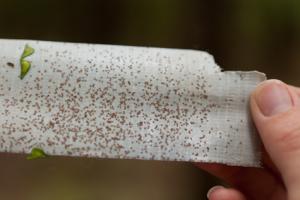
We had three times this amount on the dogs tail end. 
We treated her with the normal stuff, I use 50/50 apple cider vinegar and water in a spray bottle, a nit comb for dogs, I feed her 1/2 clove of garlic weekly and hand pick the little buggers off of her. I had no idea just how serious Seed Ticks are. Running the comb through her fur on the base of her tail exposed a lot of pepper looking almost micro-scopic eggs. My first thought was, they are laying eggs! I knew it must be bad, then I saw the live bug. Not much surprises me anymore, but that discovery blew me away. We have been fighting these things for a month, the poor dog is going crazy with the unbearable itching. Now what to do.
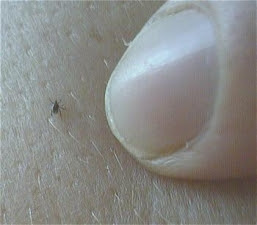
   
These guy's are tiny, this is a big one from my experience, stick it on tape and
show your Vet, she will know what to do.
The first thing we did was call the vet, (I still did not discover they were "Seed Ticks".) The Vet wanted a sample of the eggs and the live one. We are still dealing with the eggs, but could not find a live one, great. My friend texted me and suggested I look at "Seed Ticks" on line. Holy smokes, we're in an epidemic. The Vet told me that some of the popular tick and flea repellent did not work this year, many dogs are infested. One more time, Oh Great!
    The first thing we did was make a plan, more of the same comb, apple cider vinegar, garlic and flea treatment. I am switching to the pill type of repellent, it lasts 12 weeks, I'm reluctant but I'm going with it. The ticks have barbs on their mouths, allowing them to attach to the skin of the animal under the fur, difficult to remove. I am picking them off by hand. (Popular advice is to use tweezers, don't touch them.) When they hatch they burrow into the skin and attach, that's where the garlic will help. Hopefully the tick will let go when it gets a bite of it, the infestation is getting better it seems. The bites can cause an infection and serious illness to the animal if left unchecked, they must be removed. They will also find humans quite tasty as well, if we start to get tick bites the entire house must be de-bugged.
   Use tweezers to remove them, try not to leave their heads in the skin, they are tiny. Use a magnifier of some sort, my dog gets real tired of me digging around on her rear end. Use alcohol based mouthwash to remove them, sticky tape on the skin will also remove them, save one for the Vet. Give her a bath with a good flea and tick soap.
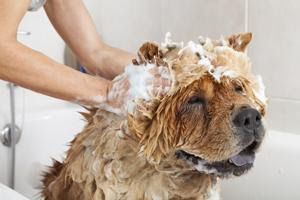
Good flea and tick soap, a warm bath will put her on a
solid path of recovery.
    They itch to the point of driving the dog insane, my dog would howl with irritation, there is a strong level of compassion from me. Benadryl, hydro-cortisone, ice packs on the skin, some essential oils work, Aloe Vera is good to use, Calamine, marigold extract will all soothe the itch. Seek medical advice, especially if you detect a fever, that means infection set in, now we have a problem. Antibiotics are the only cure after that, but if the eggs and ticks are still on her, the cycle will repeat. It's imperative to remove them. They can cause death.
    I live in a rural area, tall dry grass is the natural habitat of ticks, fleas and other parasites. Keep the lawn and as much of the area the dog frequents trimmed. I paid a gardener this morning to cut down tall weeds on my neighbors lot where my dog chases everything imaginable. Ticks live in the grass as well, on your cut lawn. diatomaceous earth spread on your lawn will kill the ticks, it drys them out, use organic not the stuff for a pool filter. The pool diatomaceous earth has chemicals in it that could harm you pet. Spread it on the approach to each door of your house. Buy a new bed for the animal, the one she has is infected. Buy one stuffed with cedar, it's a natural repellent to ticks and fleas. Wear a quality respirator, the dust is not good in your lungs.
    If you are the human in charge of all of this, be certain to wear long sleeves and trouser's. An application of bug repellent when you're outside should be applied. Before you enter the house remove your clothes, yep just like when you were 9 years old and had to strip on the stoop. Get help checking front and back, remove any ticks with tape, don't give them time to pitch a tent and camp out on your body. Shake your clothes out and immediately toss them in the washer, the dryer will kill the eggs. Finally take a shower. More information from the State of Washington here.

She'll be good to go in no time, but it will take time.
    Lyme disease, Rocky mountain fever, Tularemia and festering sores can all be the result of being bitten. It is a very serious situation. If you see your dog going absolutely out of control with itching, take a serious look around the tail up to about 8 inches towards the tail tip. Compare what you find with the pictures I have posted, if they match, they are "Seed Ticks". It has taken my wife and I three days of removal to finally realize a reduction in irritation. It seems the warm temperature is helping as well.
   I hope you never experience this, I never heard of them until my friend told me. They are different than the "wood ticks" we have all searched our dogs for, these guy's are tiny and infectious. Wood ticks have eight legs, seed ticks have six, that's one way to tell what you are dealing with.
  Thanks for reading, normally I don't write my blog this wordy however I feel this is of the utmost importance. I'd like to hear from you, I am by far not an expert on this. If you have any knowledge of these pest please share it. Thanks!

jimandkate EmergencyKitsPlus.com Dog Emergency Kits
 

Saturday, May 20, 2017

What diseases might return after an interruption of our food supply? There is one that just may rear it's ugly head......

    There were many hardships our ancestors encountered whenever they wandered away from civilization. Whether crossing the country in a covered wagon or sailing in a ship, hardship was the course of the day. Disease played a big role in their lives, the medical field was still in it's infancy in the early and mid 1800's. On the overland journey's the food that was typically packed were of the type that had a long shelf life. Flour, Salted Meats, and dried fruit were among them. One of the most endangered of the pioneers were the gold miners, it is estimated that several thousand died from "Scurvy". However it was not identified as the cause of death, mostly exposure, starvation and disease took the rap. Yes that maritime disease that many of the sailors on the tall ships suffered from, the miners shared. (For a further description of scurvy click here. )
A fresh supply of vegetables and fruit would be more than tough on a trail like this. 
    The cause of scurvy is a lack of vitamin "C", when deprived of it for 40 days the symptoms begin. Night blindness along with vision problems, wounds would not heal, gums would begin to bleed. Crippling pain in the legs and feet, swelling to the point of ending a persons mobility. The skin begins to turn black, death was on the doorstep.
    In the year of 1859 Fort Laramie experienced a scurvy outbreak which was ended by consuming cactus. A remedy taught to the forts doctor by the local Native Americans. The epidemic was caused by a lack of vitamin C, the cactus was rich in it. Within a few days of consuming vitamin C the symptoms begin to diminish. The gold miners in California would eat raisins to ward off the disease, the raisins were more valuable than gold.
It was a hard life chosen by the miners, disease was rampant.
Scurvy was a very real threat,.
    I would like to make the point I am writing this blog about, that is the question: Even though it is rare in this day and age, are we immune? The short answer is no, I can see in an evacuation event Scurvy raising it's head again. If the event last for two months or longer there is a real possibility that scurvy could return. That is the reason when we prepare our emergency kits we must include fruit and vegetables. Dried is fine however keep in mind cooking will reduce the vitamin C in it. Vegetables are rich in vitamin C as well, soup, hot dishes or just eating a carrot will keep the disease at bay.
Here's a good source of vitamin C, as
we all know. 
    We are very fortunate to live in a time when food is readily available. Abundance sometimes causes us to become complacent, assuming this will always be the case. Unfortunately there are a number of situations that could change our food supply. Drought, infrastructure failures, civil unrest or an incident like a volcano eruption. Placing us at the mercy of the supply, causing shortages, possibly starvation. (More than you want to know about Vitamin C is here.)
   
The chances of such are remote, but still possible. Scurvy makes me wonder at times just how vulnerable our society would be if as a nation we were faced with an event that compromised the food supply, what other diseases might be waiting in the wings.
    A little depressing, after reading this over it makes me hesitate to publish, but I feel there is an important message here. That message is "Be Prepared". Thanks for reading my blog, please comment, suggest new topics or just say "Hi".

Thanks jimandkate  EmergencyKitsPlus.com Dried Fruit Packs